The Jazz.com Blog
May 25, 2008 · 2 comments
Miles' New Band . . . 50 Years Later
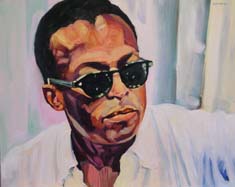
Fifty years ago today, Miles Davis brought his new band into the studio for the first time. The rookie in their midst was pianist Bill Evans, who had only been in the band around six weeks at the time of this session.
All indications (both musical and biographical) suggest that Evans had some anxieties about his role with this high-profile ensemble. A live recording from Caf Bohemia from May 17 shows him playing in a tentative and understated manner a sharp contrast from the supple, swinging presence of his predecessor Red Garland.
And who could blame the pianist for feeling some heat. Not only was he the sole white musician in the band; not only did Evans need to live up to the expectations of his mercurial boss, Miles Davis a challenging task for the best of musicians under the best of circumstances; he also had to match the intense brilliance of Miles' other front line stars, saxophonists John Coltrane and Cannonball Adderley.
No later tenorist has surpassed Coltranes influence, and his DNA has entered into the bloodstream of jazz. Even more, it has proven to be what geneticists would call a dominant trait one that over-rides other factors and influences. I remember living in Italy many years after Coltranes death, and picking up the Italian jazz magazine La Musica Jazz every month, only to find that the number one selling LP on their charts was always the same: Coltranes A Love Supreme. Other releases could fight over the silver or bronze medal, but this now departed figure would not be deprived of the gold.
In truth, one could very well make a case that even today, decades after his death, Coltrane still has more impact on how jazz is played than anyone else. His conception of improvisation has become the de facto standard for each new generation: virtuosic, scale- and pattern-driven, moving easily from modal to chord-based to free, mixing originals and standards. Even his personal tone has become an inflection in the basic sound of the jazz saxophone. Just as most of America has gradually learned to speak like Midwestern newscasters, with regional dialects gradually disappearing so have saxophonists picked up their accent from Trane. We all hear the songs through Coltranes ears now.
Coltrane follows Daviss under-stated solo on On Green Dolphin Street with some restraint of his own at least for the first twenty bars. Then come all his famous tricks. By the second chorus, the tenorist is flying over the changes, with those heady, rapid fire passages that one inspired critic aptly described as sheets of sound. But Coltrane gets short-sheeted on this performance he is forced to squeeze everything he has to say into a couple choruses, and that is a far from simple task for this loquacious soloist.
Even after I have heard this track countless times, I still am disappointed when his solo comes to end. I get the impression that Coltrane was just warming up, and was ready to work over these changes for another ten minutes or so, much as Muhammad Ali would spend ten rounds beating his pugilistic opponents into submission. I feel cheated like the folks in Lewiston, Maine who saw Sonny Liston hit the canvas after only 102 seconds of round one (roughly the same duration as this all-too-short Coltrane solo). And anyone who knew Trane realized that he might not even get to his best stuff until the seventh or eighth chorus.
In any other setting, Cannonball Adderley would be a star attraction. After all, he is the alto saxophonist who was heralded as the new Bird when he first hit the New York scene. The young Adderley would cut cats so severely at jam sessions, that his legend was almost assured even before the debut of his recording career. Adderley follows the tenor solo on Green Dolphin Street, and seems intent on showing that no one not even the mighty Coltrane can throw him off his game. He plays with blistering speed, and maybe even with a little more aggression and fire than usual could it be that matching up with Coltrane has given Adderley a kick in the backside? Years later, when leading his own band, Adderley would play funkier and looser. But in this performance his music has an edgy, riveting quality, and the altoist makes sure everyone knows that he can handle the horn, top to bottom.
How can pianist and newcomer Bill Evans possibly follow these titans. But somehow despite all the odds he does. He wont match these practice room demons note-for-note, scale-for-scale. He never did that, and I am not sure he could have . . . I recall Evans' early music teachers noting how he could play difficult pieces, but was far less impressive at scales and exercises. This pianist had many things in his bag of tricks, but demonstrations of technique, in the manner of Tatum or Peterson, were not among them. Instead he goes deeper and deeper into his own musical persona. His solo starts out with a few phrases built on single note lines, then he shifts into these thick impressionist chords, and builds his improvisation off their changing textures.
This is not modern jazz piano . . . it's more like a Debussy forced to play with bass and drums. Not only is Evans playing differently from the rest of the band . . . he is playing differently from the rest of the jazz world. No other pianist not Ahmad Jamal or Red Garland or Wynton Kelly or Oscar Peterson had this in their bag, could move the voicings around in this compositional manner. Eventually the rest of the jazz keyboard establishment would learn these techniques. But in May of 1958, Evans was a lonely prophet in the wilderness.
It would be easy to forget the bass and drums on this performance. But Paul Chambers recurring back-and-forth change from a pedal point to walking lines may be the essential ingredient in giving this track its distinctive mood. And Jimmy Cobb (the only surviving member of this band, who was recently featured in these pages) displays his noteworthy sensitivity. You can hear on this track why singers always have loved this drummer, who knows how to swing while leaving space, while opening up the musical landscape for those around him.
Is this the greatest jazz band ever? Certainly there have been all star sessions of rival proportions. Check out, for example, the 1944 Esquire All Star concert where we have Louis Armstrong, Coleman Hawkins and Art Tatum fellows who match up well, I might offer, with Miles, Trane and Evans. Even Miles had a mid-1960s combo that had as much raw musical talent as this ensemble, and blended together more effortlessly into a unified sound. The 1958 combo, by comparison, is a group of rugged individualists each of whom wants to score fifty points, shine on the slam dunk, and take the shot in the closing seconds. How they all sublimated their will to power (as Nietzsche would have called it) to make Kind of Blue is as much a psychological mystery as it is a subject for musical discussion.
Many jazz fans lament that this combo did not stay together longer, but it is something of a miracle that they kept each others company on the same bandstand for as long as they did. Fortunately for us, a few recordings document what they were able to achieve. On this anniversary of their debut studio session, jazz.com has selected "On Green Dolphin Street" as the classic jazz track of the day. For the full review and download link, click here.
This blog entry posted by Ted Gioia.
Tags:

"And anyone who knew Trane realized that he might not even get to his best stuff until the seventh or eighth chorus." Some of us (many of us, actually) see that as Coltrane's major deficiency. He never learned how to edit himself. Just as I wouldn't want to have to look through 30 of your posts to find one worth reading (fortunately, not a problem with you), so I also don't want to listen to 30 choruses of a Coltrane solo until he gets to his "best stuff." Charlie Parker, Dizzy, Hawkins and Lester could say it in two choruses (and say it brilliantly); why not Coltrane?
Miles Davis is the best jazz musican